
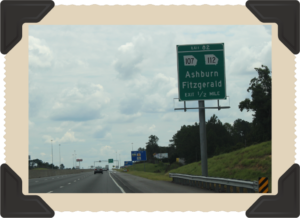
 So, there I was. Attending my first Global Trade and Investment Symposium speaking to representatives from foreign countries while sitting on a panel between a world leader in electric vehicle production and an advocate for growth in Georgia’s aerospace and defense industry. Talk about leading technologies, advanced manufacturing, and high pay/high skilled careers, not to mention global trade, imports and exports. Then there’s me. An economic development professional from Fitgerald, Georgia. As you read this, you’re thinking “Where is Fitzgerald? I’ve never heard of it”. Don’t worry, I get that all the time, and answer with, “We’re 25 miles east of Tifton. You pass through it on I-75 when you’re heading south to Disney World.” When it comes to rural, we’re about as rural as Georgia can offer.
Fitzgerald doesn’t manufacture state-of-the-art aircraft or electric vehicles, you may never ride a Waymo through our turn of the 19th century brick streets, and we don’t expect to have robots delivering our lunches or groceries anytime soon. How are we going to be relevant to this panel? How can we relate to tariffs, international disputes, and disruptions in supply chains? We’re just a small South Central Georgia farming community, right? We do make more peanut butter than any other community in Georgia that I can think of. Sitting atop the Floridian aquifer allows us to produce millions of cases of soft drinks, seltzers, and other refreshing products. We’re better suited for distributing steel and aluminum, cutting it, welding it, and fabricating utility and enclosed trailers than shaping that metal into iPhones, laptops, or any other electronic product. We’re not relevant to global trade, are we? I’m sitting at the wrong table, right?
Wrong. The moment strengthened my conviction that rural is global. In fact, many rural communities have a global footprint much larger than they realize. You know those peanuts we grow? Peanuts are grown in 75 of Georgia’s most rural counties. They don’t just end up on your PB&J, a saltine, or boiled just in time for the Georgia-Auburn game. Those Georgia Grown peanuts are now the base for a therapeutic food produced by Fitzgerald’s Mana Nutrition that is credited with saving over 2 million children’s lives. Grown in rural Georgia, value-added in rural Georgia, trucked through rural Georgia to the Port of Savannah, and then loaded on to a container ship to travel to a destination facing dire consequences. It’s Nobel Prize level work. From Anderson Memorial Church Road to the Ukraine surely sounds global to me.
The aluminum and steel that we’ll shape into modular frames and enclosed cargo trailers or used to make the 12-ounce cans we fill with Polar Beverages’ Cranberry Lime Seltzer is subject those before mentioned tariffs. Rural business owners too are rapidly adjusting to fluctuating prices, decreased demands, profit cuts. Some rely on those imported metals, some are exporting wood products, and some exporting plastics. Global decisions don’t just affect Wall Street; they trickle down to Peachtree Road in Fitzgerald too. Speaking of tariffs, I love the question I received from a partner in a much-needed wood products project we’re chasing. On a call with me the other day, he asked, “Hey you know we’re looking at purchasing close to $10 Million in equipment. All of it will come from Germany and is subject to a 25% tariff. Is there someone you can call or something you can do to see if there is a way to avoid paying the tariff?” I replied, “nope”, and then we had shared a good laugh. We’re a global player yet far from having that kind of influence.
The peanuts, corn, and chickens we grow, the aluminum and steel we import, the plastic and wood products we produce, and the cotton that we grow and no longer sew because of another global decision truly proves that rural is global. Our rural communities, or at least the ones that are surviving, realize that foreign investment brings innovators, entrepreneurs, future valedictorians, and even a Hungarian restaurant into their community. They are global players and think of themselves as relevant to global trade as Atlanta, Berlin, Tokyo, or Beijing. These are the rural communities that are making investments in infrastructure, that welcome foreign dignitaries, are respectful of culture, strive for foreign investment, and understand that doing so keeps them globally competitive.
Is rural global? My answer. How can it not be.
