
On July 4th, 1776 one of the first things the Continental Congress did after the Declaration of Independence was adopted was to appoint a committee to design a seal for the newly formed United States of America. It was a slow, deliberate and highly debated process that spanned almost 6 years. The Great Seal of the United States was finally approved by the Continental Congress on June 20th, 1782.
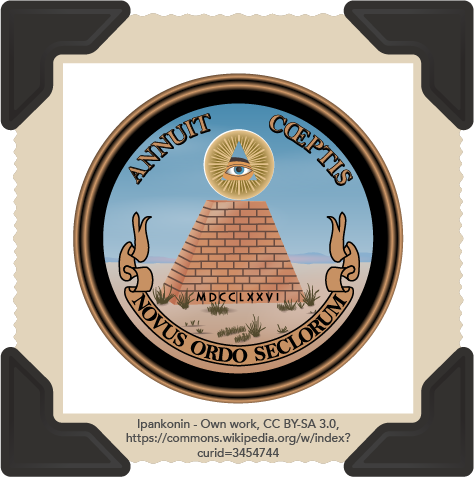 The obverse side of the seal featuring the American Bald Eagle, coat of arms, olive branches and arrows is widely used by the US Government. It appears on passports, stationary and in signage at many governmental offices. However, the reverse side of the seal with an unfinished pyramid and Eye of Providence is primarily seen on the back of the one-dollar bill. Yet it is this feature, a building, that makes the seal rare among the seals, symbols and emblems of most countries. It provides an opportunity to actually construct a building to depict it.
Some nations have statues or sculptures of their national symbols. The four lions of India come to mind. Some states have made structures to represent their seal. The arch at the University of Georgia is an example of this as it is a quasi-replica of the seal of the Great State of Georgia.
As there is ample time between now and the 250th anniversary of the adoption of the Great Seal of the United States, now is the time to explore the viability of creating a grand monument to honor this national symbol. Much like the process of adopting the seal, many questions will have to be considered. How large should it be? Where should it be? Will it simply be a monument, or will it be a functional building? What will it cost? Who will pay for it? All of these questions will need to be answered.
My personal view is that the project needs to be officially sanctioned by the US government who will award the project to the city, state or county that presents the best plan for it. The plan will not only include the design of the structure but also a plan to obtain the funding to get it built. Competition is the American way. States and localities working in partnership with the private sector frequently work together to attract new industry, sports teams and special events. This project should be approached in a similar vein with funding coming primarily from private donations.
If such a structure were built it would become a destination that no doubt would draw a large number of visitors. It would be an economic boon for the area that lands it. More importantly, it would become a national point of pride and an important teaching tool for civic education for young Americans.
Despite rumors to the contrary, the meaning behind the design of the Great Seal is no secret. Our founding fathers thought that the symbols contained in the Great Seal were important. The pyramid is a symbol of the strength and duration of the republic. The fact that the tip of the pyramid was left unbuilt shows that our country has much more work to do. Hence it is time to continue that building process and build the Great Seal of the USA! Personally, I would like to see it in Cairo, Georgia. Let the best plan and place for it win. If they build it, will you come? I certainly will.
