
As America prepares to celebrate its 250th birthday, I find myself in a unique position.
Professionally, I spend my days telling Savannah’s story to journalists, editors, broadcasters and audiences across the world. Personally, as an immigrant who chose America as home 16 years ago, I have always viewed the nation’s history with a certain curiosity. That curiosity has only deepened since moving to Savannah.
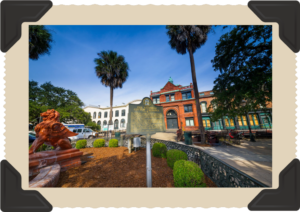 Long before the United States existed, Indigenous communities lived along Savannah’s waterways. The city’s founding depended upon relationships between English settlers, the Yamacraw people led by Chief Tomochichi and Mary Musgrove, the trader and interpreter who helped bridge cultures during the colony’s earliest years. When General James Oglethorpe and 114 settlers landed at Yamacraw Bluff in February 1733, they established what would become Georgia’s first city. More than four decades later, the Declaration of Independence would be signed in Philadelphia.
Savannah was already here.
In many ways, America 250 offers an opportunity to remember that the American story did not begin with independence. It began with experiments, ideas and communities that were taking shape decades earlier. Savannah was one of those experiments. When I tell journalists that Savannah is America’s first planned city, I usually receive one of two reactions: amazement or skepticism. Sometimes both. How can a relatively small Southern city make such a bold claim after all? Over the years, I have become accustomed to defending it.
In 1733, Oglethorpe designed a city organized around public squares that served as centers of commerce, community and defense. Nearly 300 years later, that framework remains remarkably intact. Known today as the Oglethorpe Plan, it remains one of the most influential urban planning concepts in American history. Visitors today stroll through Savannah’s 22 surviving squares beneath live oaks draped in Spanish moss. What many do not realize is that they are walking through an idea that has endured almost unchanged for nearly three centuries!
For Europeans, that may not sound particularly impressive. A city approaching its 300th birthday is relatively young by their standards. Yet what fascinates me is not simply that Savannah survived, among other things, General Sherman’s pyromania in 1864, but that so much of the city’s original psyche has survived with it. From the beginning, it represented a convergence of peoples, ambitions and identities. Places where cultures met, sometimes uneasily and sometimes harmoniously. Within a relatively compact area, visitors encounter traces of Indigenous history, colonial history, African American history, immigrant history, Jewish history, Revolutionary history and Civil War history. The city is home to one of America’s oldest Jewish congregations, the oldest continuous African American Baptist church congregation in North America, and one of the nation’s largest National Historic Landmark Districts. It is also home to a fiercely proud Irish community whose annual St Patrick’s Day celebration has become one of the largest and oldest in the United States. The influence of these communities permeates everything from architecture and cuisine to language, music and daily life. It reminds me that before there was a United States, there were places where the American experiment was already taking shape pretty well.
Recently, I spent my lunch break sitting in Chippewa Square, where the famous “box of chocolates” scene from the movie Forrest Gump was filmed. Around me, visitors snapped photographs of the iconic location. Others wandered toward the city’s bustling restaurants. A SCAD student was sketching a building façade. A few sat quietly beneath the shade of the trees. Most of us were simply there.
Yet what struck me was something less visible. The people around me were occupying a public space conceived nearly three centuries ago for exactly that purpose: to bring people together. History here is not confined to plaques, museums or guided tours, though there are certainly plenty of those. It exists in the city plan that still shapes daily life. It exists in a 300-year continuum of neighborhoods that evolve, but don’t dissolve. It exists in conversations unfolding on front porches, in public squares and along the riverfront, much like they did centuries ago, in the same places and restaurants, just different owners and decor. Before United States was founded, Savannah was already demonstrating what community, civic life and public space could look like in America’s first planned city.
America is turning 250. Savannah’s story began decades earlier.
