
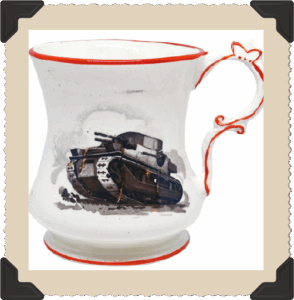
I am a dedicated collector of World War II-era items which commemorate both President Franklin D. Roosevelt and Prime Minister Winston Churchill. I personally believe Winston Churchill was, without question, the greatest leader the world has ever known. Indeed, during the recent Millennium celebrations, Churchill was voted the greatest Briton of all time by his fellow countrymen. Together he and FDR forged the most successful international alliance of the 20th Century.
There are many examples of china, glassware, textiles, and paper items commemorating the Roosevelt Churchill relationship. Later examples, produced in and after 1943, feature “The Big Three,” which then included Russian President Joseph Stalin. The china is of particular interest, as Britain has been known for centuries as one of the world’s leading manufacturers and exporters of fine china. Indeed, many of the wartime commemoratives were produced by the companies which, in the pre and postwar eras, produced some of the world’s finest tableware; Wedgwood, Spode, Doulton, and other recognized “brand names” shifted into wartime production and produced the relics collected today.
However, it is important to note these items are not merely contemporaneous souvenirs made to be sent home by soldiers and kept on home front mantles. This production was actually part of a government plan to repay Britain’s Lend Lease debt to the United States. In short, these pieces are not merely patriotic or commemorative dust collectors; they have a cherished and valued place in documenting the wartime political relationship between Great Britain and the United States, forged by two great leaders.
In the 1930’s, prior to being recalled into the Chamberlain government as First Lord of the Admiralty, was in his “wilderness years.” This description can lead to a misunderstanding that he was aimlessly wondering without focus. This is far from true. It simply means he had no government position, although he was still an MP. He used this time to write and give speeches, including one considered his best, “ The Causes of War,” broadcast over the BBC and later printed in BBC’s magazine, The Listener. It was during this time that Churchill began warning Parliament of Britain’s need to arm itself against Nazi aggression. No one listened, particularly in the face of Prime Minister Neville Chamberlain’s public assurances to the contrary. FDR began corresponding privately with Churchill, in a precedent setting maneuver to circumvent proper diplomatic channels of communication with the Prime Minister. By 1939, Britain was at war, sorely lacking in armaments and munitions, and facing ever increasing Nazi threats of invasion. Despite a diplomatic state visit that year by Britain’s King George and Queen Mary, Roosevelt’s hands were tied, even though he knew Britain needed to prepare defenses. Simply put, Roosevelt had to obey the Neutrality Act which was passed in 1939. With the recent memories of America’s losses in World War One, isolationists led by Senator Robert Taft pushed through these laws, limiting arm sales to nations that were not at war, giving the United States the power to keep citizens from traveling on belligerent ships or to belligerent nations, and prohibiting loans to belligerent nations and nations that were not repaying previous debts. Indeed, by 1940, the Nazis were as close as the British Channel Islands and Hitler had devised Operation Sea Lion, calling for the direct invasion of Great Britain.
The Lend Lease Act was passed March 11, 1941 as principal means for providing U.S. military aid to Great Britain. The Act authorized FDR to transfer arms or any other defense materials for which Congress appropriated money to “the government of any country whose defense the president deems vital to the defense of the United States.” FDR summarized Lend Lease as “helping to put out the fire in your neighbor’s house before your own house catches fire and burns down.” In effect, it turned the United States into the “arsenal of democracy” following the eruption of Nazi hostilities. By permitting FDR to ship war equipment and supplies, beginning with World War One American destroyers, to a besieged Britain without payback as stipulated by the 1939 Neutrality Act, Lend Lease empowered the British to resist the German onslaught until Pearl Harbor spurred American into conflict.
As one can imagine, all domestic manufacturing in Great Britain was turned into war production by 1939. The porcelain manufacturers were not shipping abroad and their factories had been deemed essential for the production of war necessities. Very limit supplies of china and porcelain items were produced during wartime. These were mainly patriotic in nature, and are the items we collect today to commemorate American’s aid to Great Britain. The government allowed the porcelain manufacturers to produce these items as long as a percentage of the profits were paid to the British government. These funds were earmarked specifically for repayment of the Lend Lease debt. Thus, by selling commemorative china abroad, the British manufacturers were actually aiding their country and helping to uphold the repayment provisions of Lend Lease.
The Lend Lease law originally authorized an appropriation of $1,000,000.00 in supplies to Great Britain. However, later amendments extended additional aid Great Britain, as well as to China in April 1941, to the Soviet Union in September, 1941 and eventually to thirty-five other countries. The aid was valued at $49,000,000,000.00 by the time the program was terminated in August, 1945. Some of the costs of the Lend Lease program were offset by “Reverse Lend Lease,” under which allied nations gave U.S. troops stationed abroad $8,000,000,000.00 worth of aid. Arrangements for the repayments by the recipient nations began shortly after the war ended. Except for the Soviet debt, of which less than one-third was repaid, repayment was virtually complete by the late 1960s. In 1972, the United States accepted an offer by the Soviet Union to pay $722,000,000.00 in installments through 2001 to settle its indebtedness.
